
How Injection Molding Improves Automotive Plastic Parts Quality
 shinescripts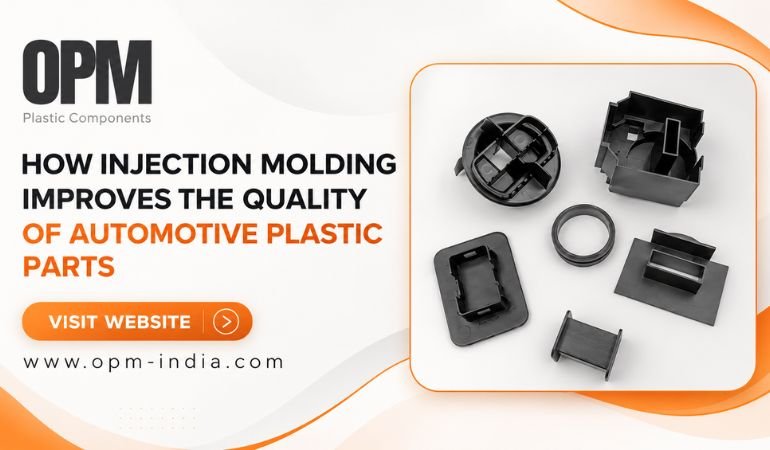
Table of Contents
- Introduction
- What is Injection molding for Automotive Plastic Parts?
- How Injection Molding Improve Automotive Injection Molding
- How OPM Helps
- Conclusion
The automotive industry requires components that deliver consistent performance, durability, dimensional accuracy, and reliable fit. As vehicles increasingly use lightweight and engineered plastic components, Plastic Injection Moulding Automotive applications have become an important part of modern vehicle manufacturing.
Injection molding allows manufacturers to produce large quantities of automotive plastic components with consistent dimensions and repeatable production quality. From interior trims and covers to under-the-hood components and other functional parts, the process can support a wide range of automotive applications.
For automotive manufacturers and suppliers, choosing the right process and manufacturing partner is essential. An experienced Automotive Injection Molding Company in Pune can support product development, tooling, material selection, production, inspection, and delivery while maintaining consistent manufacturing standards.
What Is Injection Molding for Automotive Plastic Parts?
Injection molding is a manufacturing process in which thermoplastic material is heated until it becomes molten and then injected into a specially designed mould under controlled pressure. After cooling and solidification, the finished component is ejected from the mould.
In Injection Molding Automotive Plastic Parts, the mould design, material selection, machine settings, cooling conditions, and quality-control procedures all influence the final product.
The process is particularly suitable for automotive applications because it can produce complex shapes, repeatable dimensions, smooth surfaces, and large production volumes.
How Injection Molding Improves Automotive Part Quality
- Consistent Dimensions
Automotive components often need to fit precisely with other parts or assemblies. Even small dimensional variations can affect assembly and product performance.
Injection molding uses a dedicated mould and controlled production parameters to manufacture repeated components with consistent dimensions. Proper mould design, machine control, and process monitoring help manufacturers maintain repeatability throughout production.
- Better Surface Finish
Many automotive plastic parts are visible to customers and therefore require an appropriate surface appearance. Interior trims, covers, bezels, panels, and other components may require smooth and consistent finishes.
The quality of the mould surface, material selection, temperature control, injection pressure, and cooling process can all influence the final appearance of the component.
- Complex Automotive Designs
Modern automotive components often contain complex geometries, ribs, clips, mounting points, curves, and integrated features.
Automotive Plastic Injection Molding can accommodate many of these design requirements through carefully engineered moulds. Advanced tooling and product-development processes allow manufacturers to evaluate the component before moving into high-volume production.
- Repeatability in High-Volume Production
Automotive manufacturers often require thousands or even millions of components over a product’s lifecycle. Producing consistent parts at this scale requires a controlled and repeatable manufacturing process.
Injection molding is well suited to high-volume production because the same mould can be used repeatedly under controlled production conditions. Computerized machine controls and process monitoring can further support consistency and traceability.
- Material Selection for Performance
The choice of plastic material directly affects the performance of an automotive component. Different applications may require characteristics such as impact resistance, dimensional stability, temperature resistance, flexibility, or durability.
Engineering thermoplastics such as ABS and polycarbonate can be used for suitable automotive applications. Material selection should always be evaluated according to the component’s design, operating conditions, and intended application.
- Improved Production Control
Quality does not depend only on the mould. Production parameters such as injection pressure, temperature, cooling time, cycle time, and material handling must also be controlled.
A structured production process helps identify variations and maintain consistent output. Monitoring production parameters and maintaining traceability can help manufacturers manage quality throughout the manufacturing process.
- Reduced Manufacturing Defects
Injection molding can help reduce common manufacturing issues when tooling, materials, machine settings, and process conditions are properly controlled.
Potential defects such as warpage, sink marks, short shots, flash, dimensional variation, and surface imperfections can be addressed through appropriate mould design, process development, testing, and inspection.
This is why working with experienced Plastic Auto Parts Manufacturers in Pune can be valuable for automotive companies that require repeatable production and quality control.
Applications of Automotive Injection Molding
Automotive Plastic Injection Molding can be used for a wide range of vehicle components, depending on the design, material, and performance requirements.
Common applications include:
- Interior trims and panels
- Covers and housings
- Instrument-panel components
- Door and console components
- Mounting components
- Under-the-hood plastic parts
- Exterior plastic components
- Functional automotive assemblies
- Custom moulded components
The exact material and moulding process should be selected according to the technical requirements of each component.
Why Tooling Is Important for Automotive Plastic Part Quality
The mould is one of the most important elements in injection molding. A well-designed and properly manufactured mould helps achieve dimensional accuracy, repeatability, and the required surface finish.
Before production, manufacturers can evaluate the product design, expected quantities, material requirements, and tooling configuration. Product review, development, tool trials, production parameter selection, and quality control can help identify potential production challenges before moving into full-scale manufacturing.
OPM provides an integrated approach to automotive plastic component manufacturing, covering multiple stages of the production process. With decades of experience in plastic moulded components and a focus on automotive applications, OPM supports customers from product development through production and delivery.
OPM supports customers through:
- Design & Tooling:Product and mould-development support for automotive plastic components.
- Prototyping:Prototype development and testing before full-scale production.
- Injection Molding:Production of plastic components using injection moulding machines.
- Quality Assurance:Process monitoring, inspection, and quality-control procedures.
- Assembly:Assembly services according to customer requirements.
- Storage & Logistics:Storage and distribution support for automotive customers.
For companies looking for automotive plastic parts manufacturers in Pune, an integrated supplier can simplify coordination between tooling, production, quality assurance, assembly, and delivery.
Conclusion
Injection molding plays an important role in producing high-quality automotive plastic components. Through controlled tooling, appropriate material selection, repeatable production parameters, and systematic quality control, manufacturers can achieve consistent dimensions, reliable performance, suitable surface finishes, and efficient high-volume production.
For automotive manufacturers and suppliers, selecting an experienced Automotive Injection Molding Company in Pune can provide access to technical expertise and end-to-end manufacturing support.
With capabilities covering design, tooling, prototyping, injection molding, assembly, quality assurance, and logistics, OPM provides an integrated manufacturing approach for customers looking for reliable plastic component production.
If you are looking for reliable Plastic Auto Parts Manufacturers in Pune for your next automotive component project, OPM can support your requirements from product development and tooling through production and delivery.